



Workshop on Development of Science Report on Desertification and Land Degradation within the Belt and Road Regions Successfully Held in Xinjiang
2025-12-06
An international workshop aimed at developing a comprehensive science report on desertification and land degradation across the Belt and Road regions concluded in Xinjiang recently.
The Xinjiang Institute of Ecology and Geography (XIEG) of the Chinese Academy of Sciences (CAS), co-hosted the Workshop on Development of Science Report on Desertification and Land Degradation within the Belt and Road Regions, with the Alliance of National and International Science Organizations for the Belt and Road Regions (ANSO) in Xinjiang, from Nov. 22 to 24. Approximately 50 experts and scholars from 10 countries discussed issues on desertification, land degradation, and drought across the Belt and Road regions.
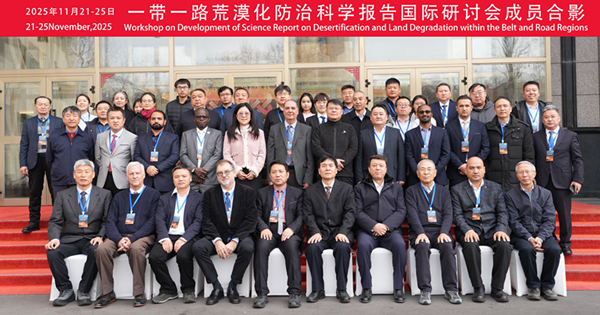
Group Photo
Prof. LEI Jiaqiang from XIEG presided over the opening ceremony on Nov. 22. He emphasized that the Science Report on Desertification and Land Degradation within the Belt and Road Regions aims to bring together various stakeholders to assess and address desertification challenges along the Belt and Road using scientific perspectives and methods.
Prof. DUAN Weili, Deputy Director of XIEG, expressed hope that the workshop would intensify global partnerships. He highlighted the potential for transforming Xinjiang's regional research strengths into shared contributions to global ecological governance through joint laboratories, shared field observation networks, and collaborative training initiatives for young scientists. He noted that these endeavors offer valuable wisdom and expertise for advancing sustainable development worldwide.
Over 60 countries along the Belt and Road face significant risks from desertification and drought. “Addressing desertification is impossible without the international exchange and cooperation,” said YI Zhijun, Deputy Executive Director of ANSO Secretariat.
Abulimiti Yili, Director of the Science and Technology Department of the Xinjiang Uygur Autonomous Region, stressed that effective desertification control technologies must be grounded in thorough regional assessments. He announced Xinjiang's commitment to collaborate with international institutions to develop desertification-control solutions. “Xinjiang hopes to disseminate successful models through international cooperation projects and offer technological assistance to Belt and Road countries through various channels to bolster their desertification control capabilities.
ZHANG Zhigang, Deputy Director of the Forestry and Grassland Bureau of the Xinjiang, briefed Xinjiang’s recent efforts and achievements in combating desertification. Xinjiang, which bears the largest expanse of desertified land in China, has long prioritized desertification control, including significant efforts to protect the periphery of the Taklimakan Desert. A 3,046-kilometer ecological barrier, designed to stabilize the desert's edge, was completed in November 2024. This project has garnered international recognition, being named one of the "TOP 10 Global Engineering Achievements of 2025."
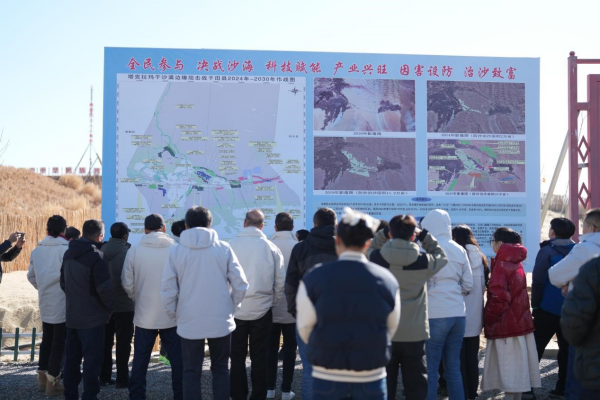
Ecological barrier project in Hotan, Xinjiang
From Nov. 23 to 24, participants embarked on a field visit to Hotan, Xinjiang. There, they witnessed the ecological barrier established along the southern edge of the Taklamakan Desert. They also visited the Cele National Field Research Station for Desert Steppe Ecosystems, where they gained in-depth understanding of XIEG’s scientific advancements in combating desertification.
During their stay in Hotan, experts engaged in detailed discussions on the outline and content of the Science Report on Desertification and Land Degradation in the Belt and Road Regions. The report aims to systematically document the shared challenges and practical experiences of Belt and Road countries, evaluate the applicability and effectiveness of various approaches, and establish a globally recognized scientific paradigm and knowledge system for desertification control. The report is scheduled to be submitted for discussion at the 17th session of the Conference of the Parties to the UN Convention to Combat Desertification (UNCCD COP 17) next year.
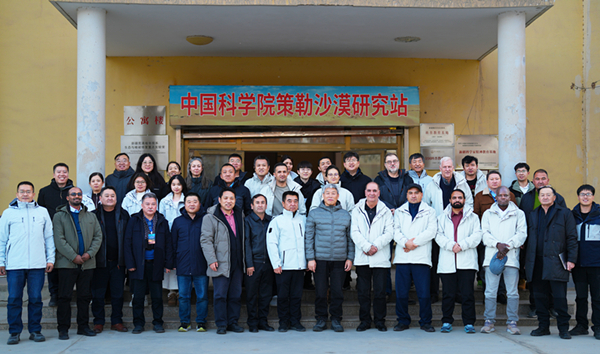
Experts Visit the Cele Station
Contact
LONG Huaping
Xinjiang Institute of Ecology and Geography
E-mail: longhp@ms.xjb.ac.cn
Web: http://english.egi.cas.cn