



Turkmen Delegation Visits XIEG, Paving Way for Enhanced Bilateral Collaboration
2025-12-16
A four-member delegation from Turkmenistan, led by Prof. Pirli Kepbanov, Director of the National Institute of Desert Flora and Fauna (NIDFF) under the Ministry of Environmental Protection, completed a significant visit to the Xinjiang Institute of Ecology and Geography (XIEG) of the Chinese Academy of Sciences (CAS) from Nov. 26 to Dec. 6, 2025.
The visit marked the first in-person engagement since the two institutions forged a cooperation agreement in September 2024. This visit signals a substantial acceleration into practical implementation for bilateral collaboration in arid-region ecology and environmental research.
During their stay, the delegation engaged in discussions at several research platforms under XIEG, including the Research Center for Biodiversity Conservation in Arid Lands, the Herbarium, the National Engineering Technology Research Center for Desert–Oasis Ecological Construction, and the Research Center of Green Development of Silk Road.
At the Research Center for Biodiversity Conservation in Arid Lands, the delegation held in-depth discussions with Prof. YANG Weikang and other researchers on topics including joint scientific expeditions, co-publishment of academic output, enhancement of personnel exchanges, and the cultivation of young scientists. A notable outcome was the mutual agreement to launch a comprehensive scientific expedition dedicated to biodiversity in the Karakum Desert.
At the Herbarium, the delegation engaged in academic exchanges with Prof. LI Wenjun, Curator of the Herbarium, and his research team, focusing on plant taxonomy, phylogenetics, and biogeography. The delegation discussed potential collaboration on joint biodiversity surveys, catalogue of plants, taxonomic and phylogenetic research, conservation of rare and endangered plant species, and the digitization of herbarium specimens in Turkmenistan.
At the National Engineering Technology Research Center for Desert–Oasis Ecological Construction, Prof. XU Xinwenand his colleagues hosted discussions under the theme of “Desertification Control Technologies and Their Applications” with the delegation. Both sides identified promising areas for future collaboration, including the assessment and mitigation of wind and sand hazards, as well as the construction of effective shelterbelts for road protection.
At the Research Center for Green Development of Silk Road, Associate Prof. FAN Lianlian shared valuable research experiences in degraded grassland restoration with the delegation. Both sides expressed strong interest in undertaking joint research, technical training, and personnel exchanges in the fields of grassland management and restoration.
Beyond discussions at the institute, from Nov. 30 to Dec. 3, the delegation embarked on a field investigation across southern Xinjiang. Their itinerary included visits to the Cistanche Cultivation Base in the Taklimakan Desert, the Tazhong Desert Botanical Garden, the Cele National Station for Scientific Observation and Research of Desert Grassland Ecosystems, and the edge-locking project sites along the southern edge of the Taklimakan Desert.
The delegation was deeply impressed by Xinjiang’s achievements and practical experience in desertification prevention and control. Prof. Kepbanov noted that China’s practices—such as using saline groundwater to cultivate sand-fixing plants, artificially cultivating Cistanche, establishing desert botanical gardens, and combating desertification based on photovoltaic technologies—have not only restored degraded lands and improved ecological conditions but also protected villages and highways while boosting local farmers' incomes. These practices offer valuable references for ecological improvement and sustainable development in Turkmenistan.
The visit by Prof. Kepbanov and his delegation has significantly propelled the bilateral collaboration between XIEG and NIDFF, deepening mutual understanding and trust, while solidifying consensus for future cooperation.
Both sides agreed to continue to implement the signed agreement under the framework of the China–Central Asia Mechanism in future. By leveraging platforms such as the China–Tajikistan Belt and Road Joint Laboratory on Biodiversity Conservation and Sustainable Use, the Biodiversity Conservation Alliance for Arid Lands, and the Research Center for Ecology and Environment of Central Asia, the two sides will jointly carry out scientific research and field expeditions, foster youth talent cultivation, and implement technical training programs, and other activities. These concerted efforts are poised to further deepen bilateral collaboration, and make a positive contribution to ecological and environmental protection, sustainable development, and scientific and technological cooperation between China and Turkmenistan.
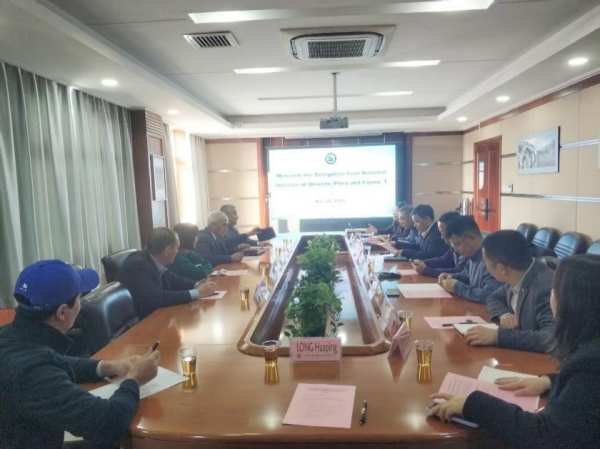
Discussion between XIEG and NIDFF
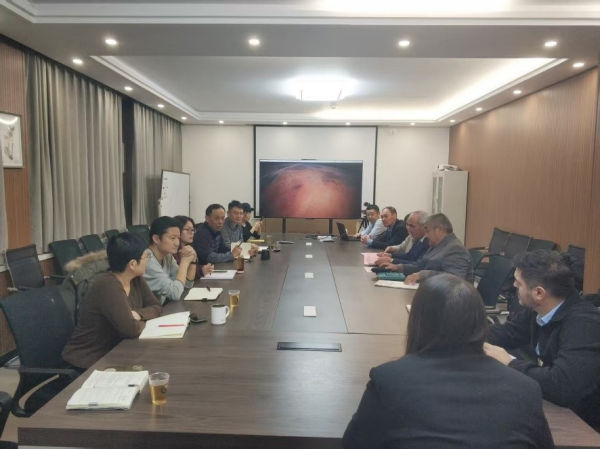
Discussion at the Research Center for Biodiversity Conservation in Arid Lands
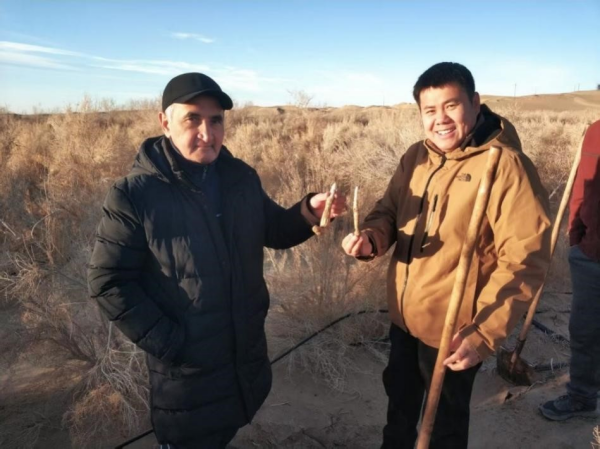
Visit to the Cistanche Cultivation Base
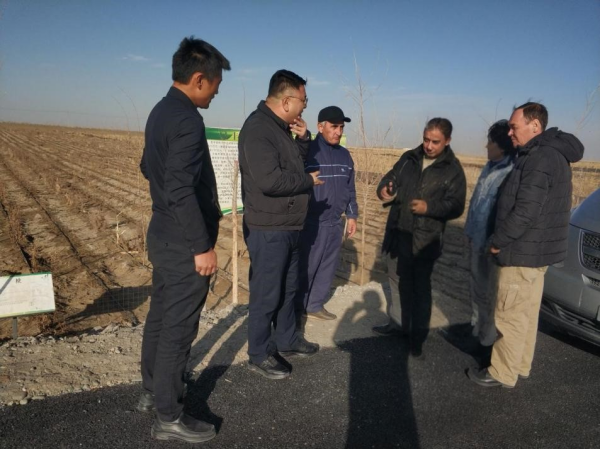
Visit to the desert control experimental station in Minfeng County
Contact
LONG Huaping
Xinjiang Institute of Ecology and Geography
E-mail: longhp@ms.xjb.ac.cn
Web: http://english.egi.cas.cn