



XIEG Conducts Joint Plant Resource Survey in Tajikistan
2026-06-30
Recently, the China-Tajikistan Belt and Road Joint Laboratory on Biodiversity Conservation and Sustainable Use (hereinafter referred to as the “Joint Laboratory”) has conducted a joint survey of plant resources in the central and western mountain areas of Tajikistan.
The research team was led by Prof. TAN Dunyan, Xinjiang Institute of Ecology and Geography, Chinese Academy of Sciences (XIEG), with Chinese and Tajik young scientists from the Joint Laboratory participating.
During the field survey, the joint team investigated 21 sampling sites covering diverse habitat types including mountain grasslands, broad-leaved forests, coniferous forests and semi-arid grasslands across multiple sites, laying a solid foundation for subsequent research on plant diversity, plant resource conservation between China and Tajikistan.
With 93% of its territory mountainous and an altitude ranging from 300 meters to 7,495 meters, Tajikistan features complex habitats and is recognized as a global biodiversity hotspot. It hosts more than 4,500 species of wild vascular plants, among which endemic and sub-endemic species account for over one-third, making it a core treasure house of mountain plant genetic resources in Central Asia.
The Gissar-Darvaz region is a core distribution area of threatened plants species. Characteristic plant groups such as Allium and Tulipa are currently threatened by human activities, and nearly half of the local threatened species lack effective protection. These challenges represent core priorities for the Joint Laboratory’s mountain plant resource conservation and utilization initiatives in Tajikistan.
Backed by the Joint Laboratory, this Sino-Tajik scientific field survey successfully completed cross-habitat germplasm resource survey tasks and further deepened bilateral scientific and technological cooperation. Researchers from both sides achieved efficient full-process collaboration, solidified the foundation for future field investigation.
The survey filled the gap in baseline plant data of central and western Tajikistan, supplemented germplasm reserves in areas not covered by previous Pamir expeditions, and further promoted the implementation of bilateral cooperation on biodiversity conservation in arid regions.
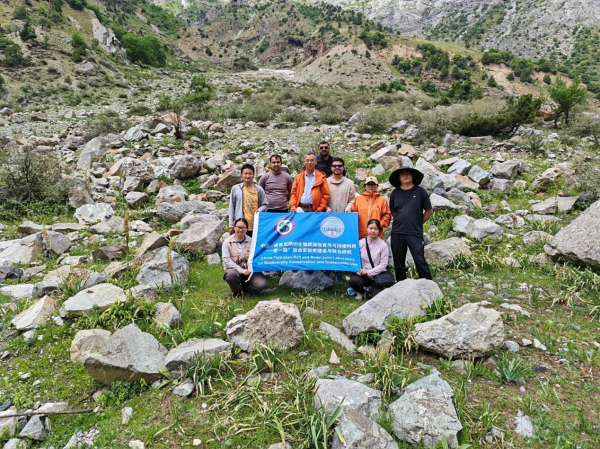
Group photo of the joint survey team. (Image by XIEG)
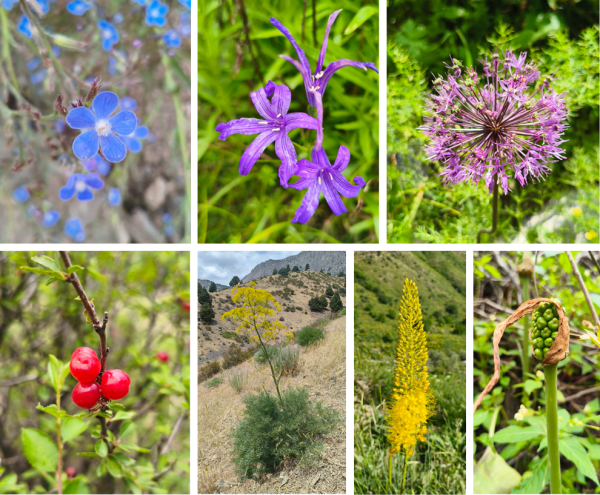
Typical plant resources in Tajikistan in June. (Image by XIEG)
Contact
Ms. HUANG
Xinjiang Institute of Ecology and Geography
E-mail: zlhuang@ms.xjb.ac.cn
Web: http://english.egi.cas.cn