



China-Kazakhstan Remote Sensing Conference Focuses on Central Asian Sustainable Development
2026-07-09
More than 80 experts from China, Kazakhstan, India, and other regional countries gathered at Al-Farabi Kazakh National University in Almaty, Kazakhstan, from June 30 to July 1 for the 2026 Annual Academic Conference of China-Kazakhstan Joint Laboratory for Remote Sensing Technology and Applications and the First Central Asia-China Symposium on Remote Sensing Technology and Applications.
The symposium strengthened regional scientific partnerships and established a forward-looking framework for collaborative innovation in remote sensing applications, ecological monitoring, ang sustainable developmentacross China and Central Asia.
Co-hosted by the Xinjiang Institute of Ecology and Geography, Chinese Academy of Sciences (XIEG), Al-Farabi Kazakh National University, and the Research Center for Ecology and Environment of Central Asia (Almaty Branch), the symposium was held under the theme “Remote Sensing Empowering Sustainable Development in Central Asia — Ecological and Environmental Monitoring in Arid Regions and Collaborative Innovation”.
Central Asia, characterized by extensive arid and semi-arid landscapes, is among the regions most vulnerable to the impacts of climate change. The area faces increasing challenges, including glacial retreat, water scarcity, land degradation, and the growing risks of natural disasters. Addressing these challenges requires advanced technologies and strengthened international scientific cooperation.
Against this background, the China-Kazakhstan Joint Laboratory for Remote Sensing Technology and Application — officially launched in 2024 under the Belt and Road Initiative — has become a key platform for bilateral science and technology cooperation. With sustained attention and support from the governments and research institutions of both countries, the Joint Laboratory has already achieved tangible progress in regional ecological monitoring, climate change research, water resource management, and disaster early warning.
In his opening address, TASYBAEV Abdrahman, Vice President of Al-Farabi Kazakh National University, emphasized that the Joint Laboratory has become a vital platform for promoting scientific exchange and joint research between China and Kazakhstan, and expressed hope for further deepening collaboration in remote sensing monitoring, geospatial information, talent cultivation, and research outcome application to jointly serve regional sustainable development across the region.
Jilili Abuduwaili, Professor at XIEG and Chinese Director of the Joint Laboratory, highlighted the critical role of remote sensing technological in supporting regional ecological security, food security, and green development. He noted that remote sensing, with its capabilities in large-scale, dynamic, and multi-dimensional observation, has become an essential scientific tool for understanding and managing environmental change. He further emphasized that XIEG will continue to utilize the Joint Laboratory as a platform to strengthen cooperation with Central Asian countries in areas including data sharing, collaborative research, researcher training, and technology transfer, thereby fostering a regional innovation community centered on remote sensing science and technology.
During the symposium, participating experts presented their latest research achievements in glacier change monitoring, landslide and debris-flow early warning, hydrological process modeling, desertification mitigation, and large-scale remote sensing foundational models. In addition to academic presentations, the event featured hands-on training sessions on remote sensing technologies, unmanned aerial vehicleapplications, and AI ethics, as well asfield visits to a high-altitude observatory facilities and the Joint Laboratory’s research infrastructure.
The symposium established a high-level, interdisciplinary dialogue platform between China, Kazakhstan, and the wider Central Asian region. It not only advanced regional consensus on global issues such as ecological security and frontier technology ethics but also deepened collaborative ties between China and Kazakhstan in environment protection, artificial intelligence, and space-based remote sensing.
More importantly, the symposium marked a new stage inmultilateral research cooperation, talent exchange, and joint innovation within the framework of international research partnerships. Through continued cooperation, the China-Kazakhstan Joint Laboratory and its regional partners are expected to make greater contributions to sustainable development and ecological security in Central Asia.
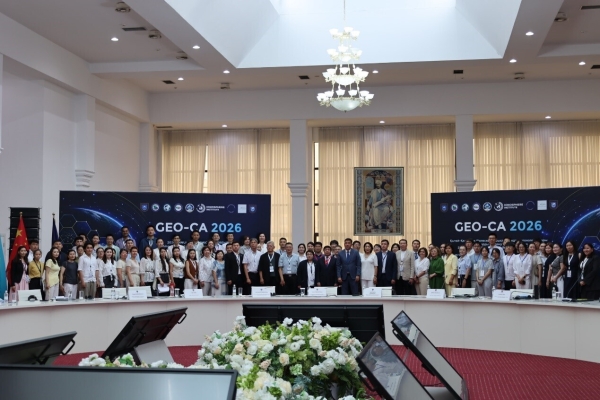
Group photo of the symposium.
Contact
Ms. HUANG
Xinjiang Institute of Ecology and Geography
E-mail: zlhuang@ms.xjb.ac.cn
Web: http://english.egi.cas.cn