



XIEG's Aral Sea Project Included in ESG in Action across Central Asian: Outstanding Practice Cases
2026-08-10
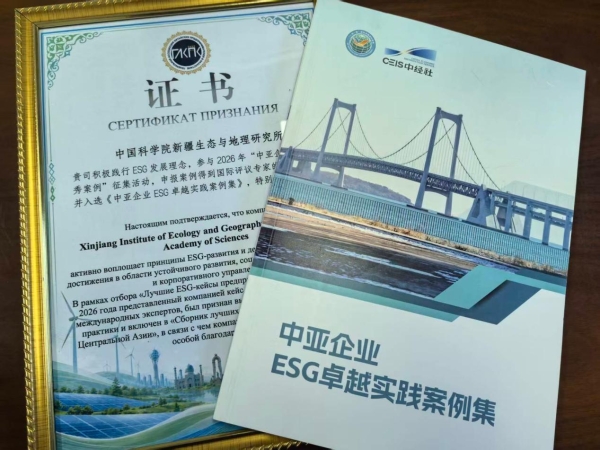
Recently, a symposium on deepening cooperation between China and Central Asia under the framework of Environmental, Social, and Governance (ESG) was held in Astana, Kazakhstan, where the “ESG in Action across Central Asian: Outstanding Practice Cases” was officially released.
The project submitted by the Xinjiang Institute of Ecology and Geography, Chinese Academy of Sciences (XIEG), “White Cotton Blooms by the Aral Sea, Green Fields Unfold Along PV Panels” — Technological Experimentation and Demonstration of Photovoltaic Applications in Aral Sea Ecological Restoration— was the only project selected from a research institution.
Hosted by China Economic Information Service and the BRI International Green Development Coalition, the event received nearly 60 applications from five Central Asian countries, covering energy, agriculture, infrastructure, finance, and other sectors. After expert review, 13 replicable and scalable real-world cases that reflect sustainable development practices in the region were ultimately included.
With support from the Alliance of International Science Organizations (ANSO) and the Aksu branch of Co., Ltd. of Xinjiang Energy and Chemical Industry Group, in partnership with the International Innovation Center of the Aral Sea Region under the National Committee on Ecology and Climate Change of the Republic of Uzbekistan, XIEG built the first 3-hectare “photovoltaic +integrated cotton water and fertilizer management” demonstration field on heavily salinized land near Nukus in Uzbekistan. Over two consecutive growing seasons, the system achieved a yield increase of over 100% and water savings of more than 30%.
In Muynak, the team developed a “photovoltaic + ecology” halophyte botanical garden, using PV water pumps to extract groundwater to cultivate more than ten salt-tolerant species including salicornia, saxaul and kalidium, alongside salt-resistant forage grasses.
The project has received high recognition from the Uzbek government and, more importantly, has provided a replicable and scalable model for saline-alkali land management in the Aral Sea basin.
Contact
HUANG
Xinjiang Institute of Ecology and Geography
E-mail: zlhuang@ms.xjb.ac.cn
Web: http://english.egi.cas.cn