



Mauritania Green Technology Park Case by XIEG Selected for Global Solicitation on Best Poverty Reduction Practices
2026-11-17
On November 11, the Announcement of Selected Cases of the 7th Global Solicitation on Best Poverty Reduction Practices was held in Beijing. The project "Demonstrating Technologies for Sand Control and Desertification Prevention to Advance Ecological Poverty Reduction in Mauritania: The China-Africa Green Technology Park Demonstration Project", jointly submitted by the Xinjiang Institute of Ecology and Geography, Chinese Academy of Sciences (XIEG, CAS), the Pan-African Great Green Wall Research Center, the "Silk Road Economic Belt" Ecological Construction Technology Demonstration International Science and Technology Cooperation Base, and the West Africa Office of the Sino-Africa Joint Research Center, CAS, was successfully selected as a recommended case and will be included in the Chinese and International Poverty Reduction Case Database.
The Global Solicitation on Best Poverty Reduction Practices was created to solicit practical cases from around the world that deliver ecological, social, and poverty reduction benefits, with the aim of building an international platform for mutual learning and exchange of poverty reduction experience among countries and promoting inclusive global development and sustainable livelihoods in dryland regions.
Located in Trarza region, Mauritania, 72 kilometers from the capital Nouakchott, the China-Africa Green Technology Park was jointly established by the National Agency for the Great Green Wall of Mauritania, Executive Secretariat of the Pan-African Agency of the Great Green Wall, and Sinoway Forest Technology Co., Ltd.
Covering an area of 4 hectares, the park is divided into 16 functional zones, displaying 35 types of desertification control materials and supporting products, and has planted more than 4,000 native plants.
It integrates technologies such as sand fixation and dune stabilization, photovoltaic water pumping, water-saving drip irrigation, desert soil improvement, and sand industry development, creating a comprehensive "photovoltaic—desertification control—sustainable livelihood" model adapted to the arid Sahelian environment.
Since its completion, the project has been producing fruits, vegetables, and forage grass, benefiting 6,000 villagers in 15 surrounding villages and gradually achieving self-sustainability. Relevant results were presented at the 16th Session of the Conference of the Parties to the United Nations Convention to Combat Desertification (UNCCD COP16).
This selection represents international recognition of the XIEG's achievements in China-Africa cooperation on desertification control and ecological poverty reduction. The case provides a new pathway for land degradation management in arid and semi-arid regions such as the Sahel, driving community income growth through ecological restoration and creating a desertification governance model that aligns with ecological, livelihood, and sustainability principles.
Going forward, XIEG will continue to leverage international cooperation platforms such as the Pan-African Great Green Wall Research Center and Association for Combating Desertification of the Alliance of International Science Organizations (ANSO-ACD) to deepen scientific research cooperation with countries involved in the African Great Green Wall, export desertification control technologies and models adapted to local conditions, contribute to ecological security and sustainable development in global arid regions, and offer Chinese solutions for the implementation of the Global Development Initiative.

Representatives at the award ceremony. (Image by the Conference Organizing Committee)
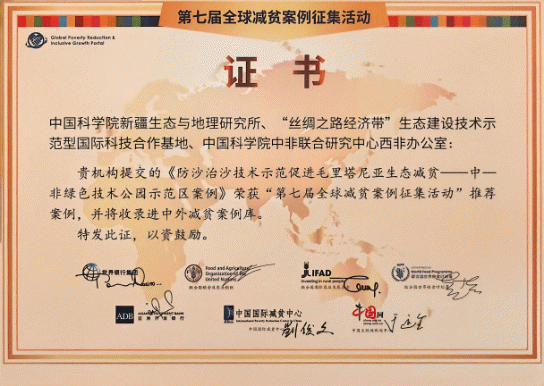
Photo of the certificate. (Image by XIEG)
Contact
HUANG Zhuanli
Xinjiang Institute of Ecology and Geography
E-mail: zlhuang@ms.xjb.ac.cn
Web: http://english.egi.cas.cn