



Ethylene and Oxygen Identified as Key Drivers of Periderm Regeneration in Plants
2025-12-11
Plants have an extraordinary ability to sense tissue damage and quickly rebuild their protective outer layers, a process vital for survival amid environmental stresses. The periderm—a specialized protective tissue found in many woody plants—serves as a crucial barrier against water loss, pathogens, and mechanical injury. However, how gaseous molecules enable plants to rapidly detect surface disruptions have long remained elusive.
In a new study published in Plant Communications on December 08, a research team led by Prof. CHEN Yaning from the Xinjiang Institute of Ecology and Geography (XIEG) of the Chinese Academy of Sciences reported new insights into gas-regulated wound signaling in plants. By examining recent advances in the field, the researchers showed that changes in the diffusion dynamics of ethylene and oxygen within plant tissues provide an efficient and rapid means of sensing breaches in surface defenses.
“When the plant’s outer barrier is damaged, endogenous ethylene gas escapes more readily into the atmosphere (efflux), while oxygen from the environment infiltrates the tissue (influx),” said Dr. Hassan Iqbal, first author of the study.
The researchers found that these shifts in gaseous gradients modify the microenvironment around the wounded area, likely triggering genetic and metabolic pathways involved in periderm regeneration. This response evovles the activation of cell division and differentiation in the phellogen, followed by the accumulation of protective compounds such as suberin and lignin, which restore the barrier’s integrity.
They also compared wound-response strategies across different plant organs. They found that in roots, dynamics of ethylene and oxygen play a pivotal role in early damage detection. Conversely, aerial tissues—which often do not develop classical periderm—may rely more heavily on volatile organic compounds, such as green leaf volatiles (GLVs), to recognize and respond to injuries. These differences highlight the diverse and specialized mechanisms plants have evolved to cope with tissue damage in various ecological contexts.
This study carries significant implications for agriculture and postharvest management. Understanding and potentially enhancing these natural wound-healing processes could help reduce crop losses during storage, improve the quality of staple crops like roots and tubers, and develop treatments or controlled storage atmospheres that promote rapid tissue regeneration.
Read the full article: https://doi.org/10.1016/j.xplc.2025.101576
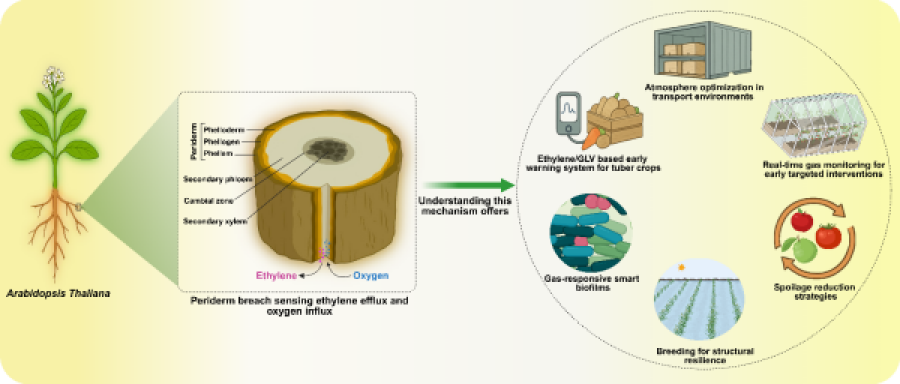
Periderm breach sensing in Arabidopsis roots and its potential applications. (Image by XIEG)
Contact
LONG Huaping
Xinjiang Institute of Ecology and Geography
E-mail: longhp@ms.xjb.ac.cn
Web: http://english.egi.cas.cn