



Researchers Propose Pareto-Optimized Windbreak Designs for Sustainable Arid Agriculture
2026-02-05
In a new review, researchers from the Xinjiang Institute of Ecology and Geography (XIEG) of the Chinese Academy of Sciences synthesized evidence and proposed a multi-objective optimization framework for designing farmland windbreak systems that can better sustain agriculture in arid regions.
Published in Agricultural Systemson on February 3, the review emphasizes that shelterbelts function as green,aerodynamic infrastructure that reduces wind erosion, buffers harsh microclimates, and stabilizes arid cropping systems.
The researchers highlighted that key design attributes, especially optical porosity, belt height and width, orientation to prevailing winds, stratification, and species mixtures significantly impact wind attenuation and field-scale benefits.
Evidence from observations and models indicates that intermediate porosity (~30-50%) typically provides the optimal balance, offering effective wind protection downwind a distance of 20 to 30 times the shelterbelt height (H). Within these sheltered zones, evapotranspiration is often reduced by 10–30%, while crop yields typically increase by 10–25%.
However, design goals can conflict. For instance, stronger wind reduction can increase water demand and crop–tree competition. The researchers advocated for Pareto-based, multi-objective optimization instead of single-criterion wind reduction. This approach seeks “best-compromise” solutions that consider wind protection, water constraints, biodiversity co-benefits, and economic practicality jointly.
For climate-adaptive planning, the review recommends integrating drought-tolerant species selection with remote sensing, geographic information systems (GIS) monitoring, and advanced decision-support tools powered by computational fluid dynamics (CFD) and artificial intelligence (AI). The review underscores the importance of locally calibrated design rules that reflect regional climate, soil, water constraints for long-term resilience.
Read the full review: https://doi.org/10.1016/j.agsy.2026.104655
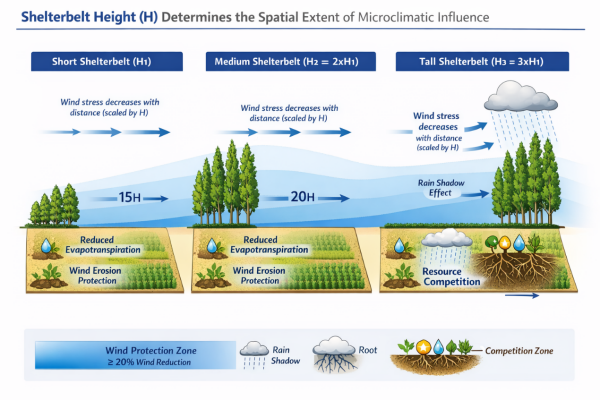
Shelterbelt height determines the spatial extent of microclimatic influence. (Image by XIEG)
Contact
LONG Huaping
Xinjiang Institute of Ecology and Geography
E-mail: longhp@ms.xjb.ac.cn
Web: http://english.egi.cas.cn