



Researchers Propose Transboundary Water Allocation Strategy for Aral Sea Basin in Central Asia
2026-03-02
The Aral Sea Basin is facing an intensifying water crisis, as escalating competition between hydropower generation upstream, agricultural irrigation downstream, and ecological needs threatens regional sustainable development. Published in The Innovation, a new study presents a coordinated water resource optimization strategy based on the Water–Food–Energy–Environment Nexus.
Led by Prof. DUAN Weili from the Xinjiang Institute of Ecology and Geography (XIEG) of the Chinese Academy of Sciences, the study introduces an innovative integration of conventional reservoirs with seasonal pumped hydropower storage (SPHS) reservoirs to ensure a fair, efficient and sustainable water allocation for food security, ecological flows, and clean hydropower production.
They found that SPHS reservoirs in mountainous regions could increase controllable upstream water resources to 42.91–58.47 × 10⁹ m³. Hydropower production could remain stable across two shared socioeconomic pathways (SSP) scenarios and three water inflow scenarios through the coordinated operation of upstream and downstream reservoirs and SPHS reservoirs.
The researchers also found that water allocation equity across all scenarios is high, with Gini coefficients below 0.29 (well under the international warning line of 0.4). To maintain ecological flows for the Aral Sea, crop areas need to be reduced 14.37%–21.05% under SSP2-4.5 and 16.16%–23.93% under SSP5-8.5. Improving irrigation efficiency and reducing crop areas were identified as critical factors for future sustainable development.
Further analysis revealed trade-offs between water allocation equity and agricultural economic benefits, while agricultural economic benefits were positively correlated with greenhouse gas emissions. The researchers emphasize that regional policy coordination and transboundary cooperation, supported by information sharing, technical assistance, and joint management, are essential to enhancing water resilience across the Aral Sea Basin.
“Traditional water management approaches that prioritize either hydropower, irrigation, or ecological needs in isolation are no longer viable,” said Prof. DUAN Weili, corresponding author of the study. “Nexus-based strategies provide a practical alternative by simultaneously addressing interlinked demands while maintaining ecological and socioeconomic balance.”
Read the full article: https://doi.org/10.1016/j.xinn.2026.101257
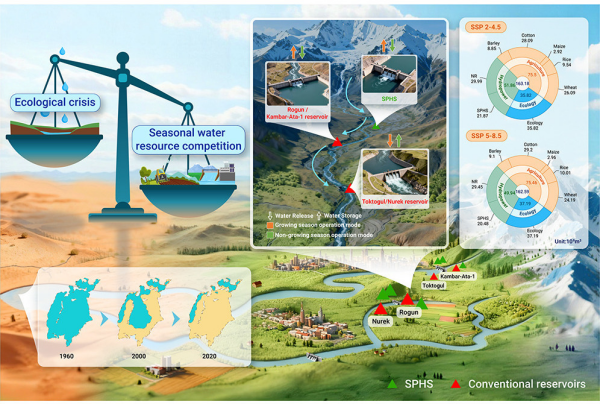
Schematic diagram for water resources in the Aral Sea Basin. (Image by XIEG)
Contact
LONG Huaping
Xinjiang Institute of Ecology and Geography
E-mail: longhp@ms.xjb.ac.cn
Web: http://english.egi.cas.cn