



Researchers Develop Framework to Decode Drought Propagation Dynamics in Glacierized Catchments
2026-05-09
A research team led by Prof. Guli Jiapaer from the Xinjiang Institute of Ecology and Geography, Chinese Academy of Sciences (XIEG), in collaboration with Ghent University, Belgium, has developed an innovative bi-stage framework to unravel how meteorological droughts propagate into hydrological droughts in glacier-fed river catchments. The study was published in the Journal of Hydrology on April 7.
Due to the influence of glacier meltwater, it is challenging to investigate the propagation process from meteorological drought to hydrological drought in glacierized catchments from the event perspective.
To address this challenge, the researchers developed a bi-stage drought propagation analysis framework (BDPF). This framework introduces the concept of recharge drought, which establishes an intermediate state between meteorological and hydrological droughts. It divides the drought propagation process into two stages, governed respectively by meltwater release and catchment controls.
Recharge drought is quantified by the Standardized Glacierized Catchment Recharge Index (SGI), which is defined as the sum of rainfall, snowmelt, and glacial meltwater and can be directly compared with the Standardized Precipitation Index (SPI) and the Standardized Streamflow Index (SSI).
The results demonstrate that the BDPF outperforms traditional frameworks in terms of event matching and interpretability. The analysis reveals drought propagation patterns at the intra-annual scale and shows that meltwater reduces drought propagation rate, duration, and severity. Furthermore, glaciers exert a more pronounced effect at the inter-annual scale, whereas catchment snow dynamics have a greater impact at the intra-annual scale.
The researchers also quantified the sensitivity of drought propagation to catchment regulatory effects. Due to the limited capacity of baseflow to buffer drought stresses, catchment control tends to amplify drought signals, thereby leading to more prolonged and severe hydrological droughts.
This study highlights the key influencing factors and complex dynamics of drought propagation in glacierized catchments, providing a theoretical basis for early drought warning systems and adaptive water resource management in cold climates.
Read the full article: https://doi.org/10.1016/j.jhydrol.2026.135461
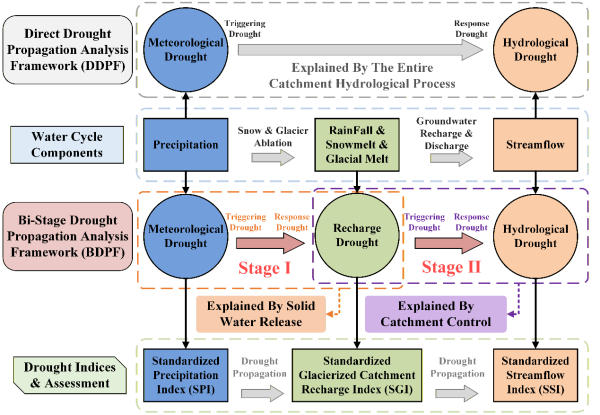
Theoretical framework for the Bi-stage drought propagation framework (BDPF) and Direct drought propagation framework (DDPF). (Image by XIEG)
Contact
PAN Xiaohui
Xinjiang Institute of Ecology and Geography
E-mail: panxiaohui@ms.xjb.ac.cn