



Study Reveals How Salt Precipitation Alters Soil Water and Heat Balance
2026-05-11
A research team led by Prof. LI Xinhu from the Xinjiang Institute of Ecology and Geography, Chinese Academy of Sciences (XIEG), demonstrated that soil texture controls the morphology of salt precipitation, which in turn governs the water and heat balance of the soil. The findings were published in Agricultural and Forest Meteorology on April 15, 2026.
The research team conducted field experiments at the Aksu National Agro-Ecological Experimental Station in Xinjiang. They compared the hydrothermal dynamics of two typical soils (silt loam and sandy soil) under saline and non-saline conditions, and developed a numerical model that can accurately simulate coupled water-heat-salt transport.
The experimental results show that in silt loam, salts form a dense, uniform crust that efficiently clogs soil pores; in sandy soil, salts initially precipitate as scattered crystals, only forming a continuous crust after reaching a critical threshold. This indicates that the ability of salt to block evaporation depends not merely on the quantity of salt but on the structure and morphology of the precipitated salt layer.
Based on the observed precipitation patterns, the researchers developed tailored mathematical functions to describe salt-induced evaporation resistance. For silt loam, a logarithmic function captures the rapid clogging of pores and the sharp rise in resistance with salt accumulation. For sandy soil, a sigmoid (S-shaped) function accurately reflects the three-stage evolution: initial lag, rapid transition, and final saturation.
The study confirms that saline soils remain warmer than salt-free soils both day and night. This is primarily because the salt crust strongly suppresses evaporative cooling (latent heat flux), leaving more energy to heat the soil.
More importantly, the research reveals that the salt precipitation pattern itself significantly affects soil temperature. The faster-forming, lower-albedo salt crust on silt loam absorbs more solar radiation, making the shallow soil layer significantly warmer than that of sandy soil.
The researchers reveal new insights on roughness and albedo effects of salt crusts. The rough salt crust on sand has a much larger actual surface area than its projected area, which partially compensates for the evaporation reduction caused by salt coverage.
In addition, salt crusts on different soils differ in color and albedo, directly affecting net radiation absorbed by the surface and thus soil thermal conditions. These findings point to clear directions for improving existing models.
“Our work bridges the gap between laboratory-based mechanistic understanding and real-world field conditions. This study is a milestone for understanding the evolution of saline lands in dry regions, predicting their responses to climate change, and developing targeted strategies for salinity control and water management,” said Prof. LI Xinhu, corresponding author of the study.
Read the full article: https://www.sciencedirect.com/science/article/pii/S0168192326000973
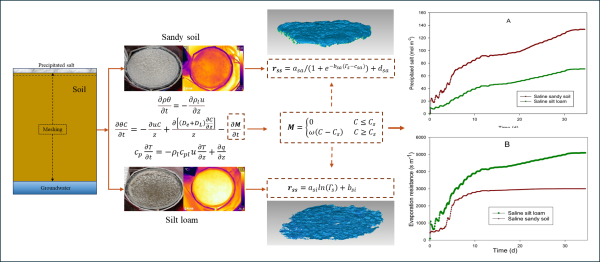
Texture‑dependent salt precipitation patterns control water and heat transport in saline soils. (Image by XIEG)
Contact
LI Xinhu
Xinjiang Institute of Ecology and Geography
Web: http://english.egi.cas.cn