



Study Develops Roadmap for Enzymatic Plastic Depolymerization from Labs to Industrial Circularity
2026-05-13
As global annual plastic output has soared beyond 430 million metric tons, the divide between lab-based enzymatic research and practical recycling applications has become critical. A research team has recently reframed enzymatic plastic recycling as a challenge that links engineering with economics and provided a roadmap to capture its value in the circular plastics market.
Led by Prof. ZHANG Yuanming and Prof. LI Wenjun from the Xinjiang Institute of Ecology and Geography, Chinese Academy of Sciences (XIEG), in collaboration with Arish University and Sun Yat-sen University, the research was published in Biotechnology Advances on May 9.
The roadmap is divided into three phases. From 2025 to 2030, the focus is on bench-scale reactors supported by predictive techno-economic analyses and life-cycle assessments (TEA/LCA) models. Between 2030 and 2035, the roadmap calls for integrated processes for mixed waste featuring real-time feedback and hybrid chemo-enzymatic systems. From 2035 to 2040, the goal is full-scale biorefineries that deploy AI-designed "smart" enzymes to handle municipal plastic waste.
“Enzymatic recycling is not a universal panacea but a specialized, high-value tool within a broader waste-management hierarchy. This clarity, and the integrated roadmap derived from it, may prove an important catalyst overall,” said Associate Prof. Osama Abdalla Abdelshafy Mohamad from XIEG.
In addition, the researchers pointed out that the core bottleneck restricting enzymatic depolymerization lies in inherent polymer chemical structures, rather than insufficient catalytic technological innovation.
They have sorted out distinct technical feasibility levels: Hydrolyzable polymers possess ester or amide backbones that allow true depolymerization, with engineered hydrolases can achieve over 90% monomer release under optimized conditions. By contrast, polyolefins, polyethylene (PE) and polypropylene (PP), possess chemically inert C–C backbones for which no native enzymatic cleavage pathway is known.
Artificial intelligence and machine learning (AI/ML) have greatly expedited enzyme screening and development, boasting a classification accuracy of over 90% in discovering new hydrolases, yet they cannot ensure stable operational efficiency at solid-liquid interfaces in actual waste treatment scenarios. Likewise, bioinspired multi-enzyme cascades and customized cellulosomes exhibit great potential in substrate channeling, while their large-scale application prospects rely heavily on process-oriented engineering improvement instead of mere molecular structure optimization.
In terms of economic benefits, the study revealed that cost-optimized enzymatic polyethylene terephthalate (PET) recycling can reach cost competitiveness with virgin plastic production at a cost range of $1.1-1.8 per kilogram. As for polyolefins, direct enzymatic recycling is economically unviable, and combined pyrolysis-biological conversion hybrid technologies represent the only viable development route.
Read the full article: https://doi.org/10.1016/j.biotechadv.2026.108919
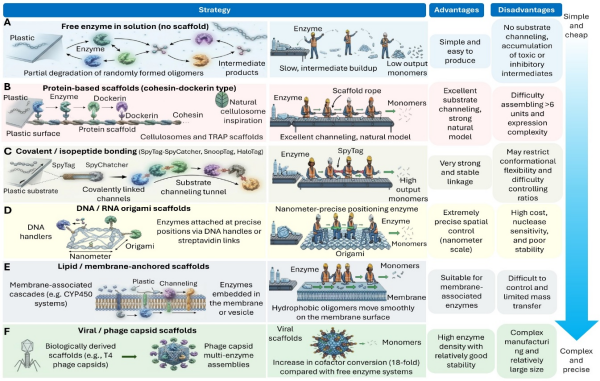
Fig. 1. Main strategies for spatial organization and coordination of multienzyme cascades applied (or potentially applicable) to plastic depolymerization and upcycling. (Image by XIEG)
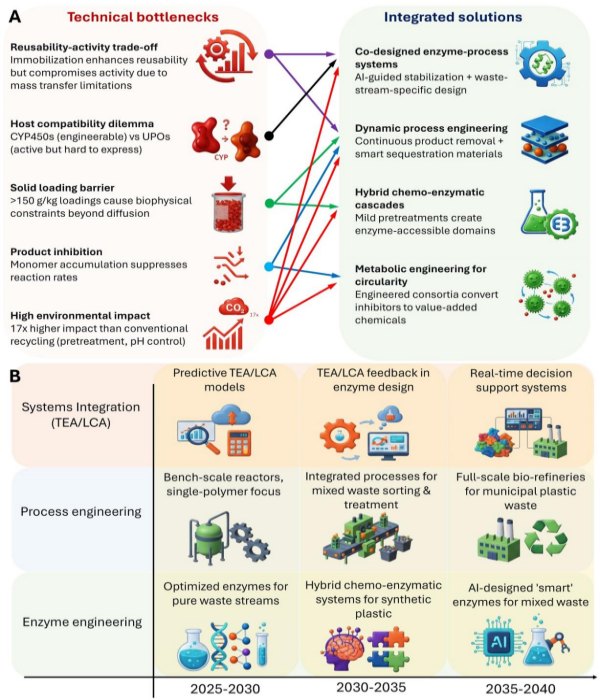
Fig. 2. Current challenges and future roadmap for enzymatic plastic recycling. (Image by XIEG)
Contact
Osama Abdalla Abdelshafy Mohamad
Xinjiang Institute of Ecology and Geography
E-mail: Osama@ms.xjb.ac.cn
Web: http://english.egi.cas.cn