



Study Reveals the Resilience and Resistance of Arid Vegetation in Northwest China
2026-05-14
Global climate change, including warming, shifting precipitation, and frequent extreme weather events, is profoundly altering terrestrial ecosystems. In drylands, vegetation sensitivity and resilience to climate change are critical for ecological stability.
A research team led by Prof. YU Yang from the Xinjiang Institute of Ecology and Geography, Chinese Academy of Sciences (XIEG), systematically analyzed vegetation sensitivity and resilience in Northwest China’s arid region—a core area of global mid-latitude drylands.
The study was published in Ecological Indicators on March 28, 2026.
The research team constructed an Enhanced Vegetation Index and Vegetation Sensitivity Index (EVI-VSI) synergetic framework and combined XGBoost-SHAP with the AC1 framework.
The researchers found that the EVI significantly increased, while the VSI showed a non‑significant decline. After 2010, a shift point emerged characterized by a weakening temperature dominance and a strengthening radiation dominance.
In semi‑arid zones, the radiation‑dominated areas surged, while in arid zones, precipitation played a dominant role (34.90%), significantly higher than the 12.86% observed in humid zones. This reveals a transition in driving mechanisms, described as “radiation substituting for temperature.”
The study reveals that resilience followed an “east high, west low” pattern, with a significant overall increase and 2017 as a turning point for most subregions. The drivers were climate‑dominated but regionally heterogeneous: temperature‑dominated, hydrothermal‑coupled, precipitation‑dominated, and hydrothermal‑radiation‑nutrient coupled across different subregions.
These complementary studies reveal the spatiotemporal dynamics and regulatory mechanisms of vegetation sensitivity and resilience, providing a scientific basis and technical parameters for differentiated ecological restoration. The findings also support global mid‑latitude dryland management and UN SDG 15.3 (Land Degradation Neutrality).
“Our framework advances the understanding of dryland vegetation responses to climate change and offers integrated tools for ecosystem monitoring, risk assessment, and climate‑adaptive restoration,” said YU Yang.
Read the full article: https://doi.org/10.1016/j.ecolind.2026.114693
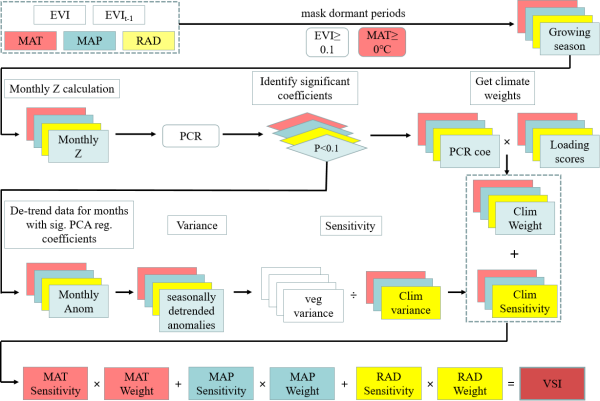
Flowchart for calculating the Vegetation Sensitivity Index (VSI). (Image by XIEG)
Contact
YU Yang
Xinjiang Institute of Ecology and Geography
E-mail: yuyang@ms.xjb.ac.cn
Web: http://english.egi.cas.cn