



Study Reveals How Melatonin Mitigates Lithium Toxicity in Wheat
2026-05-15
A research team led by Associate Prof. Mohsin Tanveer from the Xinjiang Institute of Ecology and Geography, Chinese Academy of Sciences (XIEG), in collaboration with Prof. Sergey Shabala from the University of Western Australia, reveals that melatonin regulates potassium (K+) homeostasis by regulating redox control, restoring cellular energy levels and reprogramming K+ transporters.
The study was published in the Journal of Hazardous Materialson on February 23, 2026.
In typical arid and semi-arid environments, low rainfall and high evaporation rates limit soluble salt leaching, causing saltto accumulate in the root zone and intensifying lithium pollution. Recycled wastewater used in such regions often contains elevated levels of metals and pollutants, further exacerbating soil contamination. Therefore, understanding and mitigating lithium (Li) toxicity is vital for maintaining agricultural productivity in drylands.
While the physicochemical similarity between Li and sodium (Na) offers some parallels to salinity stress, Li toxicity presents unique physiological challenges. One of the most critical and immediate damages is the disruption of K+ homeostasis. K+is an essential macronutrient, vital for enzymatic functions, membrane potential control, and osmotic regulation.
“In thisstudy, an integration of high-resolution non-invasive microelectrode ion flux estimation (MIFE) with confocal laser scanning microscopy was used to examine the dynamics of K+ homeostasis across the plasma membrane in wheat roots under Li stress,” said Special Research Assistant Waqas Ud Din Khan, first author of the study.
The researchers discovered that Li stress triggers a catastrophic collapse of K+homeostasis in wheat roots, reducing K+uptake by over 60%.
This is not merely due to ionic competition but is primarily driven by a burst of reactive oxygen species (ROS) from NADPH oxidases (RBOH enzymes). This ROS burst activates GORK, a depolarization-activated K+efflux channel, causing cells to leak their vital K+reserves, a physiological "bleeding out" that precedes programmed cell death.
This study deeply dissects the micro-physiological processes underlying plant responses to emerging metal pollution and reveals the key mechanism by which the phytohormone melatonin alleviates lithium toxicity in wheat. It provides a critical mechanistic understanding for safeguarding food security in regions facing emerging soil contamination.
Read the full article: https://doi.org/10.1016/j.jhazmat.2026.141593
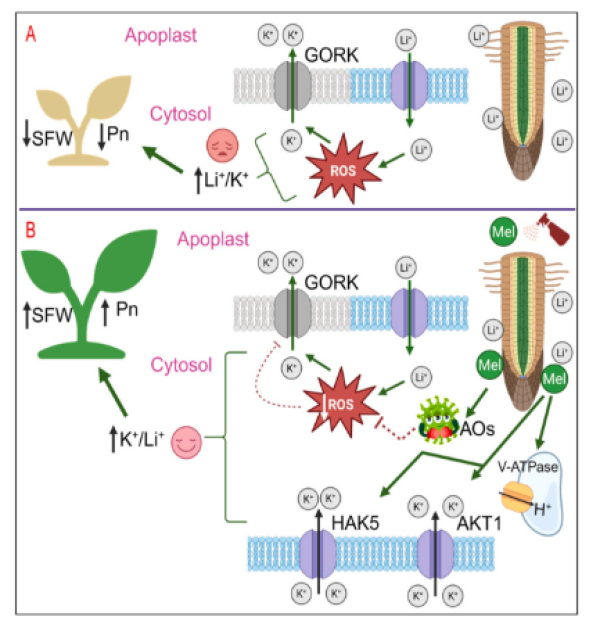
A model depicting the mechanisms contributing to root ion homeostasis with and without melatonin under Li stress affecting the shoot growth. Created in BioRender. Khan, W. (2025)
Contact
Mohsin Tanveer
Xinjiang Institute of Ecology and Geography
E-mail: mtanveer@ms.xjb.ac.cn
Web: http://english.egi.cas.cn