



Study Reveals Melatonin Reprograms Li Sequestration and Nitrogen Assimilation in Wheat Roots
2026-05-19
A research team led by Associate Prof. Mohsin Tanveer and Prof.WANG Lei from the Xinjiang Institute of Ecology and Geography, Chinese Academy of Sciences (XIEG) revealed that melatonin can orchestrate a coordinated defense against lithium (Li) toxicity in wheat, restoring nitrogen metabolism. The findings were published in Journal of Agricultural and Food Chemistry on March 5, 2026.
"Li stress reduces nitrogen utilization by inhibiting the activities of key enzymes in nitrogen assimilation," said Dr. Tanveer, first author of the study. "This creates a metabolic bottleneck that severely constrains growth, even when nitrogen is abundant in the soil."
The researchers observed that beyond the dramatic recovery of nitrogen content in melatonin-treated roots (which was 97% higher than in melatonin-untreated stressed plants), the mechanistic details reveal how melatonin coordinates multiple pathways through an expansive transcriptional network.
Nitrate transporter genes NRT1 and NRT2.1 showed 179% and 356% increases in expression, respectively, in melatonin-treated roots under Li stress, while untreated roots showed 33% and 43% reductions. The core assimilatory enzymes, such as nitrate reductase and nitrite reductase, all showed restored or enhanced activity and gene expression.
Thestudy reveals that melatonin establishes functional coupling between apoplastic Li sequestration and nitrogen metabolism; the physical defense enables the metabolic process to proceed.
"It's a strategic prioritization," explains Prof. WANG, corresponding author of the study. "The cell wall modifications were established during the 72-hour melatonin pretreatment period, before Li exposure. This physical defense was in place and ready, allowing metabolic processes to continue despite external stress."
RNA sequencing revealed the scale ofthe coordination of these metabolically demanding processes (cell wall remodeling, nitrogen assimilation, and antioxidant defense).Li stress altered expression of 138 transcription factors, while melatonin pretreatment under Li stress regulated 1,388, a tenfold expansion.
"This isn't random activation of stress responses," notes Dr. Tanveer. "Melatonin orchestrates a coordinated program that prioritizes resources, establishes physical defense, and then enables metabolic recovery."
The study demonstrates that melatonin-mediated Li sequestration in the root cell wall establishes a functional foundation for nitrogen metabolism recovery by preventing cytosolic Li accumulation and protecting nitrogen-assimilatory enzymes from inactivation. The strong positive correlation between cell wall Li content and nitrogen uptake in melatonin-treated roots, absent in untreated plants, confirms that apoplastic immobilization of Li is causally linked to restored nitrogen assimilation rather than merely coincidental.
This mechanistic coupling between physical defense and metabolic function explains how melatonin enables wheat to maintain productivity in lithium-contaminated soils, sequestering the toxin outside the cell while preserving the nitrogen assimilation machinery essential for growth.
Read the full article: https://doi.org/10.1021/acs.jafc.5c13751
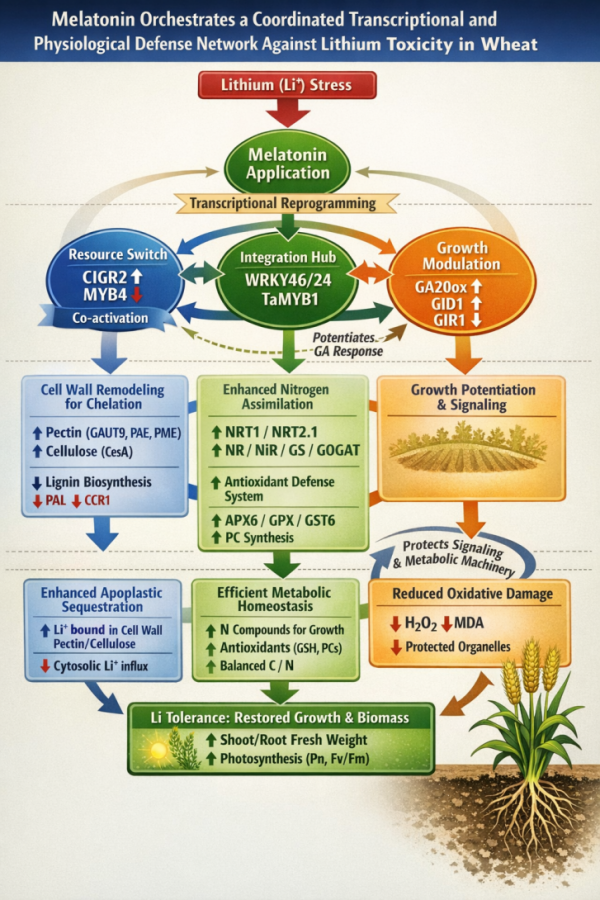
A proposed integrated model of melatonin (Mel)-mediated transcriptional reprogramming for lithium (Li) tolerance in wheat. (Image by XIEG)
Contact
Mohsin Tanveer
Xinjiang Institute of Ecology and Geography
E-mail: mtanveer@ms.xjb.ac.cn
Web: http://english.egi.cas.cn