



Study Reveals Aridity Gradient Dominates Topsoil Microbiome Assembly in Tianshan Wild Fruit Forest
2026-05-25
A research team led by Prof. ZHANG Yuanming and Prof. LI Wenjun from the Xinjiang Institute of Ecology and Geography, Chinese Academy of Sciences (XIEG), in collaboration with researchers from Henan University, found that the aridity gradient, rather than vegetation degradation, is the paramount factor shaping the forest’s topsoil microbiome. This finding upends conventional understanding and guides targeted conservation efforts.
The study was published in Current Research in Microbial Sciences on March 24, 2026.
The Tianshan wild fruit forest is a rare temperate relict forest ecosystem, a global biodiversity hotspot, and a key gene pool for cultivated fruit trees. Currently, this ecosystem is experiencingsevere degradation. The traditional view holds that vegetation degradation is the core factor driving microbial communities.
In this study, 360 topsoil samples were collected from the northern and southern slopes of the Tianshan Mountains. Using high-throughput sequencing technology, the research team systematically analyzed how aridity gradients and ecosystem degradation regulate the topsoil microbiome, and clarifiedthe key driving factors and ecological mechanisms.
The results show that the aridity gradient explains approximately 43% of the variation in bacterial communities and 30% in fungal communities, while degradation level has no significant effect on microbial α- and β-diversity.The core microbiome of this ecosystem is highly stable, with community assembly dominated by stochastic processes, microbial co-occurrence networks are significantly more complex and stable than those in semi-arid and humid regions.
Functionally, soil microorganisms mediate key ecological processes such as nitrogen and carbon cycling, with nitrogen cycling as the dominant function. Groups including Rhodoplanes, Alcaligenes, and Rhizobiadrive this process, and nitrate reduction is particularly active in humid and semi-arid habitats.
This study confirms that aridity gradients can override degradation effects and become the core regulator of the microbiome in arid mountain ecosystems, providing critical scientific evidence for the conservation of the Tianshan wild fruit forest.
The research team suggests that ecological conservation efforts should prioritize water resource allocation and management, strengthen habitat protection in dry sub-humid regions, and maintain the functional stability and resilience of ecosystem microorganisms to address ecological degradation risks under global climate change.
Read the full article: https://doi.org/10.1016/j.crmicr.2026.100586
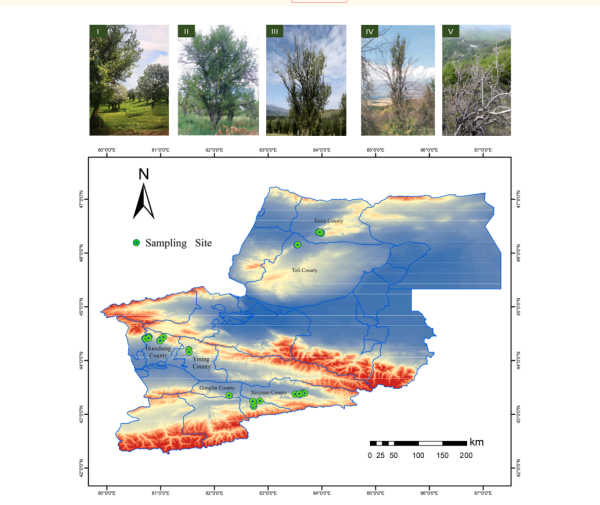
Fig. 1. The sampling sites of the Tianshan wild fruit forest. (Image by XIEG)
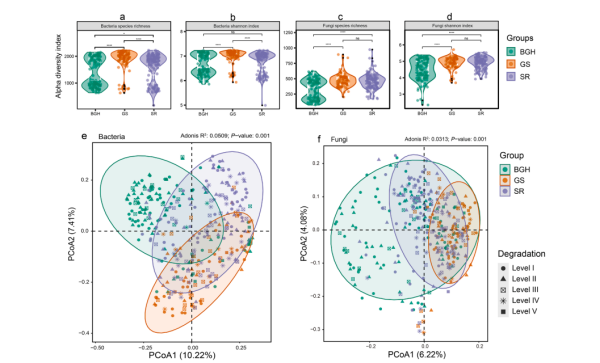
Fig. 2. The alpha diversity and beta diversity of bacteria and fungi in wild fruit forest under different aridity gradients. (Image by XIEG)
Contact
LIU Yonghong
Xinjiang Institute of Ecology and Geography
E-mail: liuyh@ms.xjb.ac.cn