



Study Reveals Microenvironment-Driven Soil Heterogeneity Regulates Soil Enzyme Activities
2026-06-08
A research team led by Prof. LI Yaoming from the Xinjiang Institute of Ecology and Geography, Chinese Academy of Sciences (XIEG), reveals that microenvironment-driven soil heterogeneity modulates soil enzyme activities during the snowmelt period in a temperate desert. The study was published in Catenaon March 12, 2026.
Soil enzymes play a critical role in driving organic matter decomposition and nutrient mineralization, and are essential for nutrient acquisition by plants and microorganisms. Their activities are regulated by both biotic and abiotic environmental factors and exhibit significant specificity across different ecosystems. However, how micro-environmental factors influence soil enzyme activity during the snowmelt period in desert ecosystems remains poorly understood, limiting the understanding of nutrient cycling mechanisms in arid regions.
To address this, the researchers collectedsoil samples from three slope positions (top, middle, and bottomof a typical sand dune)over a two-week period during the snowmelt season in 2019,and measured the activities of eight key soil enzymes involved in carbon (C), nitrogen (N), and phosphorus (P) cycling.
Using redundancy analysis and structural equation modeling, the team systematically analyzed the direct and indirect effects of slope position, soil moisture, aboveground biomass, and soil nutrients on enzyme activity, revealing the mechanisms by which microtopography-driven soil heterogeneity modulates soil enzyme activity during the snowmelt period.
The results showed that soil enzyme activity exhibited significant spatiotemporal variation. Over the sampling period, the activities of C-, N-, and P-acquiring enzymes all showed an increasing trend, with most enzyme activities being significantly higher at the dune top than at the bottom.
The water pulse triggered by snowmelt was the primary driver of soil enzyme variation, explaining over 50% of the variance. The negative effect of soil moisture on enzyme activity was mainly attributed to nutrient leaching during snowmelt.
Topographic position interacted with hydrological variation to shape complex spatiotemporal patterns of soil biogeochemistry. The study underscores the importance of integrating microtopographic heterogeneity and snowmelt hydrology into the management of arid desert ecosystems.
Read the full article: https://doi.org/10.1016/j.catena.2026.109993
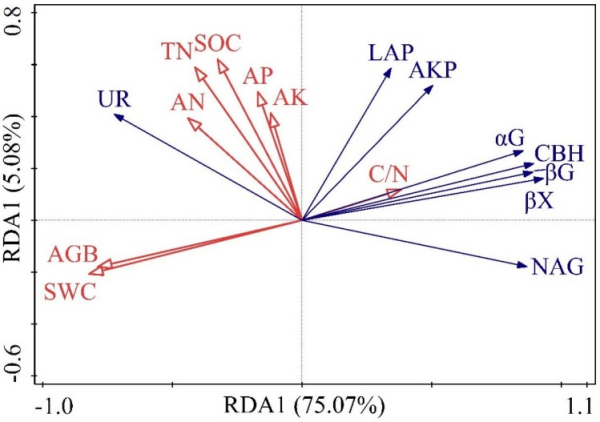
Fig. 1. Redundancy analysis of soil enzyme activity with soil properties and AGB. (Image by XIEG)
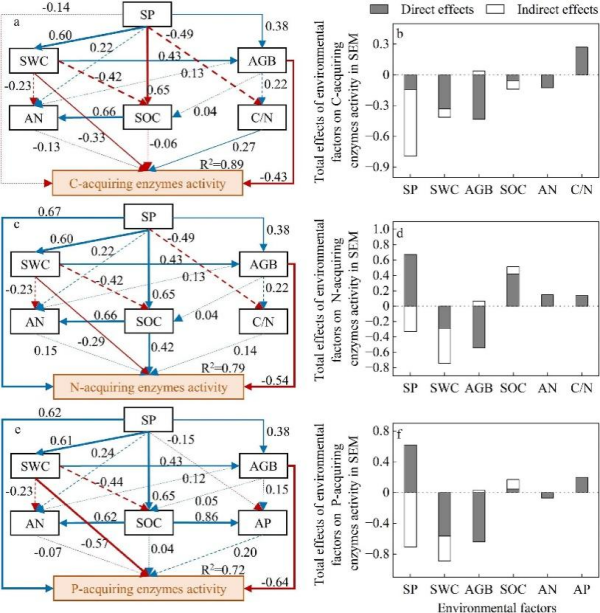
Fig. 2. Structural equation model of the impact of environmental variables on soil enzyme activity. (Image by XIEG)
Contact
FAN Lianlian
Xinjiang Institute of Ecology and Geography
E-mail: flianlian@ms.xjb.ac.cn