



Study Reveals the Hydraulic Strategies of Desert Shrubs to Cope with Drought and Freezing Stresses
2026-06-17
A research team led by Prof. ZHANG Yuanming from the Xinjiang Institute of Ecology and Geography, Chinese Academy of Sciences (XIEG), has revealed xylem adaptation of desert shrubs to both drought and freeze-thaw stress. The finding was published in Plant, Cell & Environment on May 27, 2026.
In deserts of Northwest China, plants are subjected to chronic water deficit and recurrent seasonal frost stress, both of which pose a principal threat to plant hydraulic safety by causing xylem embolism and losing water transport function. Some desert species have evolved protuberances associated with pit chambers or outer pit apertures, so called vestures, but the adaptive significance of such pit structures remains understudied.
Using the live collections of a temperate desert botanical garden in Northwest China, the researchers conducted comprehensive comparisons of structural and hydraulic functional characteristics between five shrub species with vestured pits and five ones without pit vesturing.
The results show that shrub species with vestured pits exhibit both higher hydraulic efficiency and stronger resistance to drought-induced embolism, while they are more vulnerable to freezing-induced embolism. Contrasts in hydraulics between the two functional groups is parallelled by xylem structural characteristics at both tissue and pit levels. Particularly, species with vestured pits possess larger vessel diameter, larger pit membrane area and smaller pit membrane thickness.
Vesture formation contributed to greater drought resistance while allowing for relatively high hydraulic efficiency. This would be of great adaptive significance in deserts, where maintaining hydraulic integrity during long-lasting drought and transporting water efficiently following significant rainfall events are both important. Nevertheless, higher vulnerability to freezing-induced embolism may have limited adaptability of vestured-pit shrubs to frost-prone environments.
Collectively, this study advances understanding of the complexity of xylem adaptation, showing for the first time how pit vestures in combination with other xylem anatomical features shape hydraulic adaptations of shrubs to drought and frost in desert environments.
Read the full article: https://onlinelibrary.wiley.com/doi/epdf/10.1111/pce.70630?domain=author&token=XUXMCVY9NJTSIGHR64WS
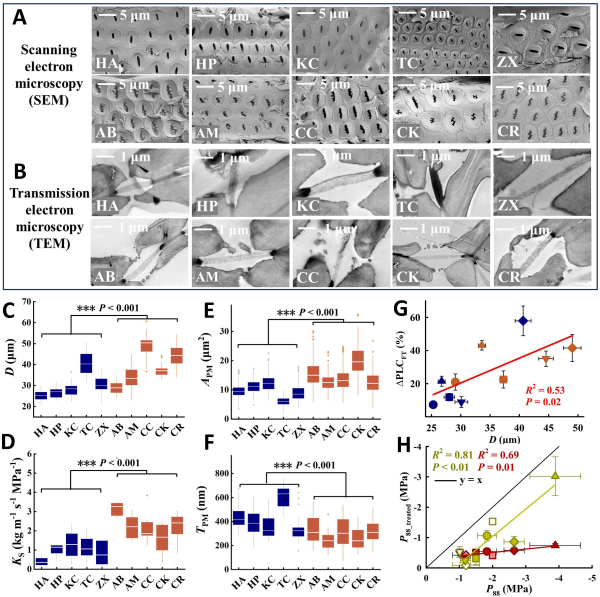
Stem xylem structural and hydraulic functions in the desert shrub species with non-vestured pits or vestured pits. (Image by XIEG)
Contact
DUAN Chunyang
Xinjiang Institute of Ecology and Geography
E-mail: duanchunyang@ms.xjb.ac.cn