



Study Reveals Tissue-Specific Metabolic Responses of Soybean to Nitrogen Deficiency and High-Temperature Stress
2026-08-26
A research team led by Associate Prof. Mohsin Tanveer from the Xinjiang Institute of Ecology and Geography, Chinese Academy of Sciences (XIEG), in collaboration with Prof. Alisdair R. Fernie from the Max-Planck-Institute of Molecular Plant Physiology, has revealed how soybean roots and leaves employ distinct metabolic strategies under nitrogen deficiency and high-temperature stress. The studywas published in Journal of Advanced Research on August 7, 2026.
Climate change is increasing the co-occurrence of nutrient limitations and elevated temperatures, which together pose a serious threat to crop productivity. However, most previous studies have focused on individual plant organs, and the coordinated metabolic responses of roots and leaves remain poorly understood.
The researchers subjected soybean plants to control, nitrogen-deficient (–N), high-temperature (HT), and combined conditions (HT–N). They integrated physiological assessments with untargeted metabolomic profiling of roots and leaves.
Machine-learning and network analyses, including t-SNE (t-distributed stochastic neighbour embedding), UMAP (uniform manifold approximation and projection), WGCNA (weighted gene co-expression network analysis), and RFR (random forest regression), were used to identify tissue-specific metabolic signatures. Selected findings were further examined using quantitative PCR and absolute metabolite quantification.
Combined HT–N stress caused the most severe growth inhibition, reducing shoot length by 67%, root fresh weight by 52%, and the photosynthetic efficiency (Fv/Fm) by 51% compared with the control.
Metabolomic analysis revealed distinct responses between the two tissues. Under –N, roots prioritized nitrogen assimilation and accumulated glutamate, proline, and aspartate. Under HT stress, leaves accumulated more flavonoids, indicating enhanced antioxidant protection. Under combined HT–N, roots primarily adjusted amino acid and proline metabolism, whereas leaves reprogrammed phenylpropanoid and glutathione metabolism.
The study further identified glucose, proline, flavonoids, and several amino acids as key candidate metabolites associated with physiological performance under stress.
This study demonstrates that soybean roots and leaves perform complementary but functionally distinct roles in responding to simultaneous nutrient and temperature constraints.
“The identified metabolic signatures may support the development of soybean varieties with improved tolerance to high temperatures and greater nitrogen-use efficiency,” said Special Research Assistant Hamza Tariq, first author of the study.
Read the full article: https://doi.org/10.1016/j.jare.2026.08.017
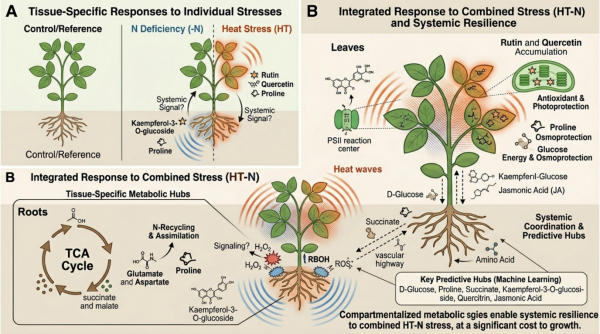
A proposed model showing the tissue-specific coordination of metabolite profiling conferring combined high temperature and nitrogen deficiency stress. (Image by XIEG)
Contact
Hamza Tariq
Xinjiang Institute of Ecology and Geography, Chinese Academy of Sciences
E-mail: hamza@ms.xjb.ac.cn
Web: http://english.egi.cas.cn