



Study Reveals MgO Nanoparticles Reduce Lead Bioaccessibility and Enhance Nutritional Quality in Mungbean Sprouts
2026-09-23
A research team led by Prof. WANG Lei and Associate Prof. Mohsin Tanveer from the Xinjiang Institute of Ecology and Geography, Chinese Academy of Sciences (XIEG), has found that magnesium oxide nanoparticle (MgO-NP) priming can improve lead (Pb) tolerance and nutritional quality in mungbean sprouts through coordinated physiological and metabolic responses. The findings were published in Food Chemistry on September 9, 2026.
Soil salinization is a growing constraint on agricultural productivity in Xinjiang and other arid regions, where saline irrigation water and high evaporation intensify salt accumulation in soils. Salinity not only limits crop growth but may also increase the mobility and bioavailability of heavy metals such as Pb, amplifying the risk of contaminant accumulation in edible crops. Addressing both salinity-related constraints and heavy metal accumulation is therefore important for sustainable food production in Xinjiang and similar saline environments.
In this context, mungbean sprouts offer a promising perspective for resource-efficient food production. Mungbean seeds can be converted within a short production cycle into nutrient-rich edible biomass, providing a potential circular-economy pathway for generating value from plant-based resources. However, because sprouts are consumed whole and with minimal processing, they are particularly vulnerable to Pb accumulation, which poses direct toxicological risks and degrades the nutritional quality of edible tissues. Ensuring nutritional quality and limiting the bioaccessibility of contaminants remain important considerations when developing such production systems for environmentally constrained regions.
“Understanding how MgO-NP priming influences Pb accumulation, antioxidant metabolism, and the bioaccessible fraction of Pb provides a more comprehensive basis for evaluating its potential application in edible sprouts,” said Dr. Muhammad Saqib Bilal from XIEG, the first author of the study.
The researchers combined physiological and biochemical analyses, elemental profiling, untargeted metabolomics, weighted gene co-expression network analysis (WGCNA), and INFOGEST-based in vitro gastrointestinal digestion to compare MgO nanoparticles with bulk MgO under Pb stress.
Their results showed that MgO-NP priming improved germination (93% vs. 87% with MgO-bulk) and growth under Pb stress while reducing Pb accumulation in edible sprout tissues by 62.5%, compared with 36.4% for bulk MgO. MgO-NP also enhanced antioxidant capacity, with total antioxidant capacity increasing by 138% relative to Pb stress alone, and was associated with greater accumulation of phenolic- and flavonoid-related metabolites.
An additional bulk MgO dose-response experiment showed that increasing the bulk MgO concentration up to 600 mg/L did not reproduce the overall germination and growth response observed with MgO-NP at 100 mg/L.
Metabolomic and WGCNA analyses further revealed coordinated changes in phenylpropanoid and flavonoid metabolism, supported by higher phenylalanine ammonia-lyase activity. Importantly, INFOGEST-based digestion showed that MgO-NP treatment reduced the potentially bioaccessible Pb fraction by 76.3% compared with Pb stress alone while maintaining higher Mg bioaccessibility under Pb exposure (21% vs. 18% with MgO-bulk).
This study provides new insights into MgO-NP priming under Pb stress and highlights the importance of gastrointestinal bioaccessibility when evaluating the safety and nutritional quality of edible sprouts. The findings may also support resource-efficient, stress-resilient food production in arid and saline regions, and offer a practical strategy for producing safer sprouts in Pb-contaminated environments.
Read the full article: https://doi.org/10.1016/j.foodchem.2026.151056
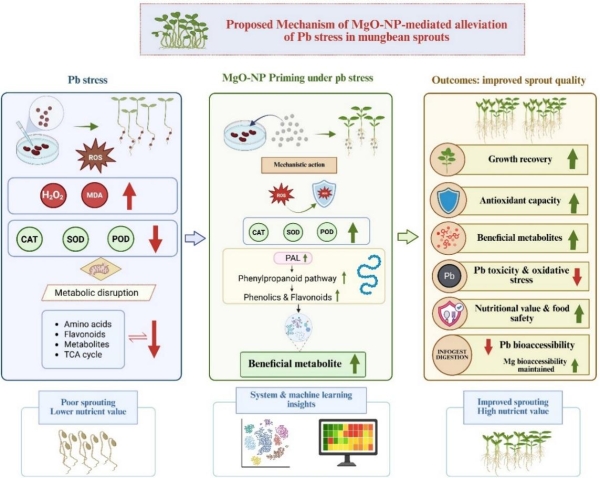
A proposed mechanism of MgO-NP-mediated mitigation of Pb stress and improvement of mungbean sprout quality. (Image by XIEG)
Contact
Mohsin Tanveer
Xinjiang Institute of Ecology and Geography
E-mail: mtanveer@ms.xjb.ac.cn