



Study Reveals How Plant Diversity Drives Productivity in Dryland Herbaceous Communities
2026-09-30
A research team led by Prof. ZHANG Yuanming from the Xinjiang Institute of Ecology and Geography, Chinese Academy of Sciences (XIEG), has revealed progress in understanding how herbaceous plant diversity drives productivity in dryland ecosystems. The study was published in Plant Diversity on May 12, 2026.
Ecosystem productivity in drylands is constrained by multiple factors, including water scarcity, nutrient-poor soils, and climatic variability. Although plant diversity is widely recognised as an important driver of ecosystem productivity, it remains unclear whether productivity along aridity gradients is governed primarily by niche complementarity among species or by the functional traits of dominant species. Clarifying how the relative importance of these mechanisms changes across environmental gradients is essential for understanding the maintenance of ecosystem functioning in drylands and for developing restoration strategies tailored to different levels of water availability.
To address this question, the researchers established 56 survey sites along an approximately 2,100-km east-west precipitation gradient across northern China. The transect encompassed six major desert and sandy-land regions: the Gurbantunggut Desert, Badain Jaran Desert, Tengger Desert, Ulan Buh Desert, Kubuqi Desert, and Mu Us Sandy Land.
The team integrated measures of taxonomic, functional, and phylogenetic diversity and systematically evaluated the relative contributions of plant diversity and dominant-species functional traits to community productivity.
The results identified a mean annual precipitation threshold of approximately 168 mm, marking a transition between the two productivity-regulating mechanisms. Below this threshold, community productivity was driven primarily by functional diversity and complementarity among species, while plant communities were characterised mainly by stress-tolerant strategies. Above the threshold, functional traits of dominant species, particularly plant height and specific leaf area, became increasingly important in determining community productivity. Along this gradient, the predominant community strategy shifted from stress tolerance towards competitive resource acquisition.
These findings demonstrate that ecological restoration and productivity management in drylands should account for local moisture conditions. In extremely water-limited areas, restoration efforts should prioritise the conservation of species with diverse resource-use strategies and the maintenance of community functional diversity. In semi-arid regions with relatively favourable moisture conditions, greater attention should be given to key traits of dominant species, including plant height and specific leaf area, as well as to the appropriate selection and configuration of species with strong resource-acquisition capacities.
Read the full article: https://www.sciencedirect.com/science/article/pii/S2468265926001149?via%3Dihub
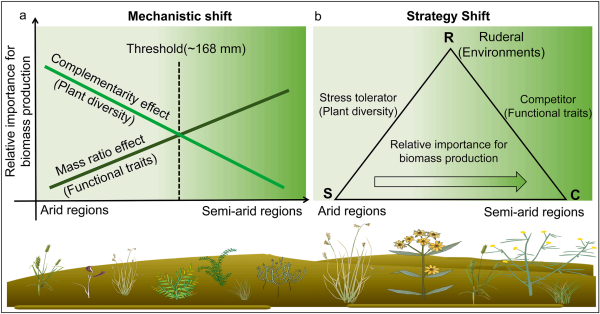
Schematic illustration of how herbaceous plant diversity contributes to community productivity. (Image by XIEG)
Contact
GUO Hao
Xinjiang Institute of Ecology and Geography
E-mail: guohao@ms.xjb.ac.cn
Web: http://english.egi.cas.cn