



Study Reveals Urban Vegetation Mitigate Compound Hot–Dry Events across Chinese Cities
2026-11-12
A research team led by Prof. BAO Anming from the Xinjiang Institute of Ecology and Geography, Chinese Academy of Sciences (XIEG), has revealed that urban vegetation modulates compound hot-dry events (CHDEs) across Chinese cities, with leaf area index (LAI) effects differing between event frequency and intensity. The study was published in Weather and Climate Extremes on August 8, 2026.
Under global warming and rapid urbanization, extreme heat and drought increasingly occur together, threatening human health, ecosystem functioning, and urban infrastructure. Although urban vegetation is widely recognized as an effective nature-based solution for reducing heat, its capacity to regulate compound hot–dry events remains poorly understood, particularly at the national scale.
To address this gap, the research team examined the spatiotemporal patterns of CHDEs in 231 Chinese cities from 2000 to 2024, integrating 1-km daily maximum temperature, standardized precipitation evapotranspiration index (SPEI), satellite-derived LAI, impervious surface data, and topography. This framework enabled them to assess the relationship between urban vegetation and compound climate extremes under different environmental conditions.
The results show that Chinese cities experienced about 12 CHDEs days per year on average, with a slight upward trend. Northern cities, particularly those in arid and semi-arid regions, generally experienced more frequent events, and CHDE intensity was also higher in the north.
However, cities with the most frequent events were not always those facing the greatest intensity. Parts of Northeast China, the Yangtze River Delta, and the Sichuan Basin formed distinct high-intensity hotspots despite moderate occurrence, indicating that evaluating frequency alone may underestimate urban climate risks.
A major finding of the study is the ecological buffering role of urban vegetation. LAI was negatively associated with CHDE frequency across approximately 51.12% of the study area. The relationship was strongest in central China and humid–semi-humid transition zones, but weaker in the water-limited drylands of Northern China. These differences demonstrate that the benefits of urban greening depend strongly on local water availability and climatic conditions.
The study further shows that frequency and intensity are governed by different processes. Precipitation was the dominant factor controlling CHDE frequency, with a relative contribution of 64.7%, whereas temperature and potential evapotranspiration (PET) played greater roles in determining event intensity.
Comparisons among the Beijing-Tianjin-Hebei, Central Plains, Yangtze River Delta, and Guangdong-Hong Kong-Macao Greater Bay Area urban agglomerations further revealed distinct regional combinations of climatic drivers.
These findings provide a scientific basis for region-specific urban greening and climate adaptation. In humid and semi-humid cities, ecological buffering capacity can be strengthened by improving vegetation cover and canopy continuity. In arid and semi-arid cities, greening strategies should integrate drought-tolerant plant selection, appropriate green-space design, and water-saving irrigation to avoid additional pressure on limited water resources.
Read the full article: https://doi.org/10.1016/j.wace.2026.100943
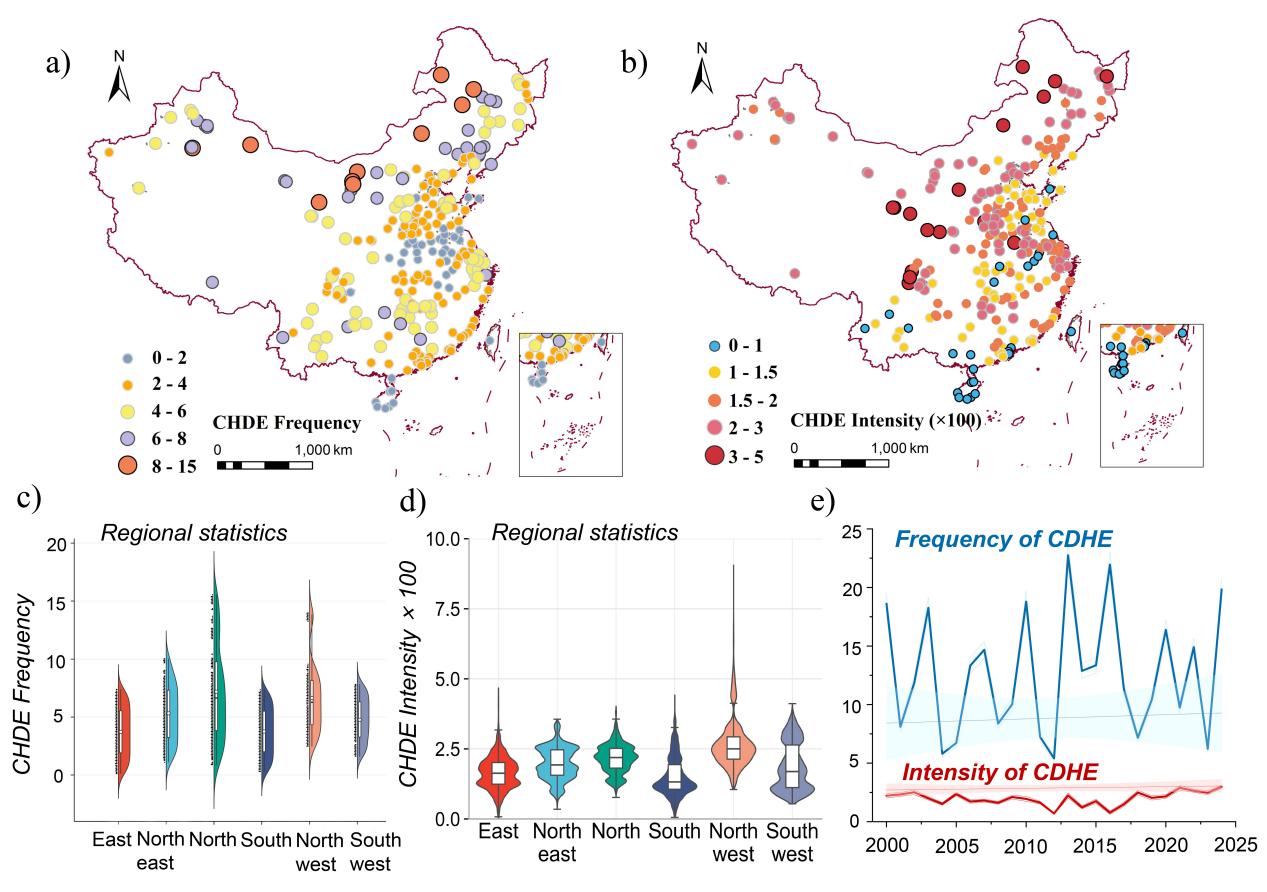
Spatial and temporal characteristics of urban CHDEs in China from 2000 to 2024. (Image by XIEG)
Contact
SONG Fengjiao
Xinjiang Institute of Ecology and Geography
E-mail: songfengjiao20@mails.ucas.ac.cn
Web: http://english.egi.cas.cn