



Study Reveals How Microbial Life-History Strategies Shape Desert Biocrusts Multifunctionality Under Snow Cover Change
2026-11-18
A research team led by Prof. ZHANG Yuanming from the Xinjiang Institute of Ecology and Geography, Chinese Academy of Sciences (XIEG), has revealed the biocrust-type-specific responses of soil multifunctionality (SMF) to long-term changes in snow cover and the underlying microbial regulatory mechanisms. The study was published in Global Change Biology on November 7, 2026.
Winter snowfall is an important source of water in desert ecosystems and plays a critical role in sustaining the survival and ecological functioning of biological soil crusts (biocrusts). However, global climate change is substantially altering winter snow-cover patterns, with potentially profound consequences for the structure and functioning of desert biocrusts. How different biocrust types respond to long-term changes in snow cover, and how microbial life-history strategies contribute to the regulation of SMF, remain poorly understood.
To address these questions, the research team conducted a long-term field snow-manipulation experiment in a temperate desert. Focusing on cyanobacterial and lichen biocrusts, the researchers established three snow treatments: snow removal (SR), ambient snow (CK), and double snow (DS;additional snow transferred from the snow-removal subplots).
They compared the responses of SMF to snow manipulation across plots representing different treatment durations (1, 8, and 11 years) and investigated the potential underlying mechanisms by examining microbial diversity, microbial life-history strategies, and soil physicochemical properties.
The results revealed distinct responses of SMF to altered snow conditions between the two biocrust types. Short-term snow manipulation (1 year) significantly increased SMF in cyanobacterial crusts, whereas SR significantly reduced SMF in lichen crusts. As treatment duration increased, the differences in SMF between altered-snow treatments and ambient snow conditions gradually diminished in both biocrust types, indicating that biocrust type and treatment duration jointly influenced responses to changes in snow cover.
Regarding the underlying microbial mechanisms, snow manipulation primarily increased bacterial and total microbial diversity in lichen crusts, whereas significant diversity responses in cyanobacterial crusts were primarily associated with fungi. Random forest and structural equation modeling analyses further demonstrated that the relationships between microbial life-history strategies and SMF differed markedly between the two biocrust types.
In cyanobacterial crusts, SMF was negatively associated with the stress-tolerance strategy (S strategy), while metabolic pathways related to the high-yield strategy (Y strategy) were positively associated with SMF.
In contrast, SMF in lichen crusts was positively associated with the resource-acquisition strategy (A strategy) but negatively associated with the S strategy. These findings highlight the important role of microbial life-history strategies in maintaining the ecological functioning of desert soils.
This study provides new insights into the potential microbial mechanisms underlying these responses and contributes to a better understanding of the stability of desert ecosystem functioning under climate change.
In future research, the team will integrate long-term field monitoring with experiments designed to validate microbial functions, further investigate how different biocrust types adapt to changes in snow cover, and clarify the specific roles of microbial life-history strategies in maintaining SMF, thereby providing a stronger scientific basis for assessing the functional stability and adaptive capacity of desert ecosystems under global environmental change.
Read the full article: http://doi.org/10.1111/gcb.71194
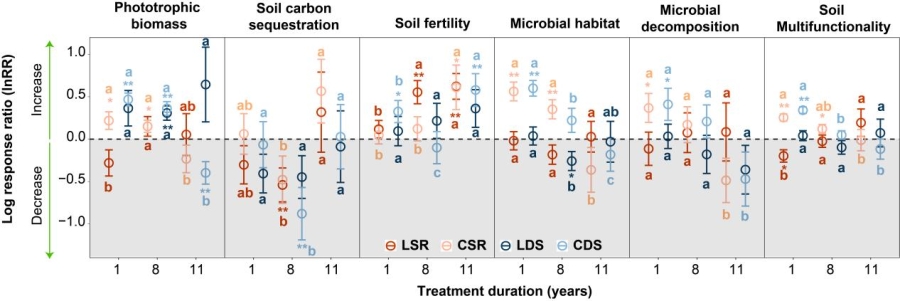
Fig. 1. Changes in individual soil functions and soil multifunctionality induced by snow manipulation across different treatment durations. (Image by XIEG)
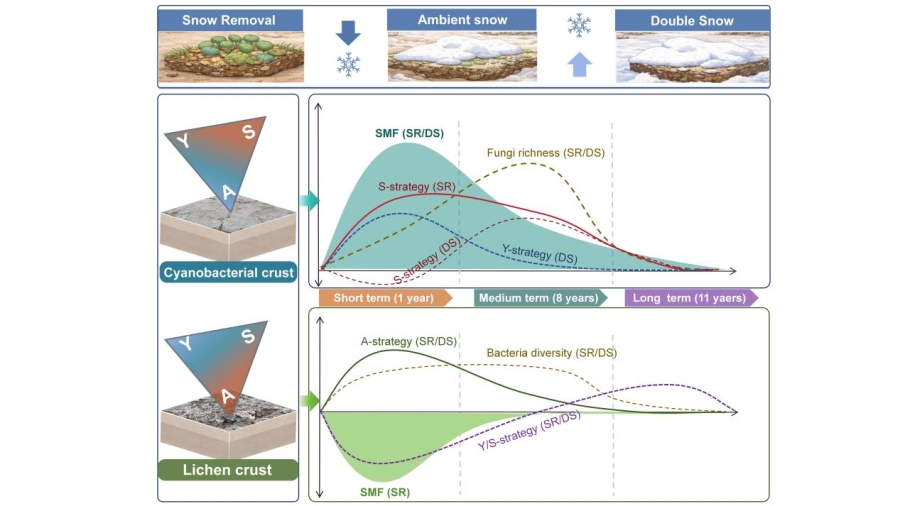
Fig. 2. Schematic illustration of the microbial regulatory mechanisms underlying soil multifunctionality responses to long-term changes in snow cover in cyanobacterial and lichen crusts. (Image by XIEG)
Contact
ZHANG Qing
Xinjiang Institute of Ecology and Geography
E-mail: zhangq_1141@163.com
Web: http://english.egi.cas.cn